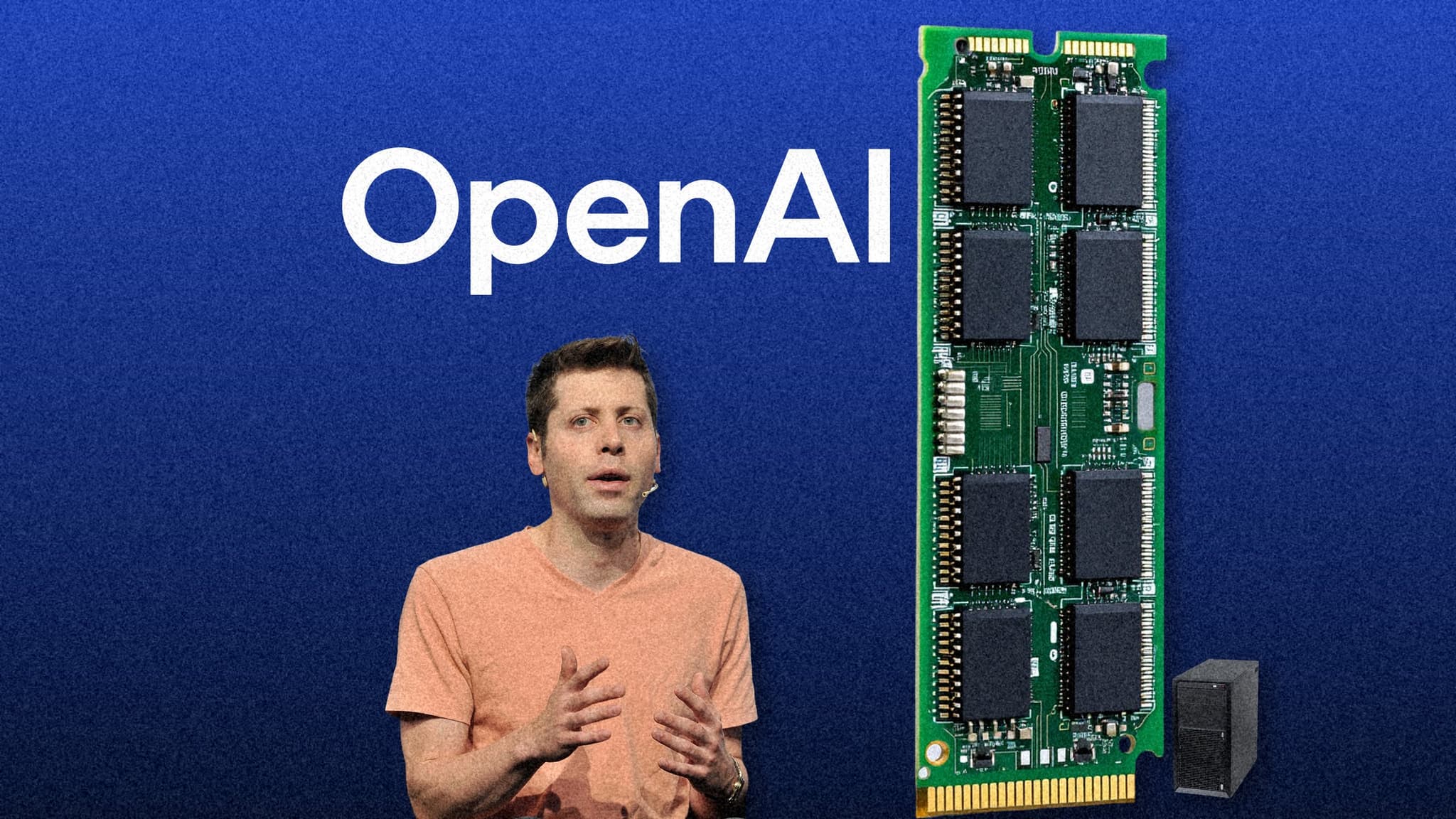
OpenAI CEO Sam Altman said the memory chips sitting in the world's personal computers are a poor use of a scarce supply. "From a global allocation perspective, actually, it's quite terrible to have everybody have a bunch of the world's limited supply of DRAM sitting in their own computer and being used 5% of the time," he told Stripe co-founder John Collison on the Cheeky Pint episode published October 29, about 29 minutes in, Tom's Hardware reported. "You want maximum utilization in the cloud if you're trying to deal with this very supply-constrained environment."
Two days later Altman was in Korea with the two memory makers OpenAI signed supply letters with last year. On Saturday, October 31, he met about 50 Samsung executives at the group's training center in Yongin, south of Seoul, Yonhap reported, and had lunch in Seoul with SK Group Chairman Chey Tae-won, joined by senior SK hynix and SK Telecom executives, The Herald Business reported. No agreement was announced after either meeting.
SaasBuzz's lead on Saturday morning was the money side of the AI compute crunch: investors growing pickier about funding OpenAI and the neoclouds. This piece is the supply side. Our finding: DRAM contract prices are on course to end 2026 about three times where they started, by SaasBuzz's compounding of quarterly figures reported by TrendForce, and SK hynix, one of the two suppliers Altman visited, says its output is effectively sold out through 2029. Altman's remark is a buyer's argument in that market, and it points to the cloud, where OpenAI sells.
What Altman said, and what happened in Seoul
Altman was answering the idea that open-weight models running on people's own machines will reduce the need for data centers. "A lot of people want local inference. And somehow, they assume that the problem is solved now," he said, as quoted by The Next Web. Tom's Hardware quoted him finishing the point: "And somehow many people's intuition is the opposite of that."
He also described what the shortage is worth to the chipmakers. Memory makers were "each going to make like $100 billion of free cash flow in a year," he said, according to The Next Web's account of the episode. The 5% figure is his own estimate; he did not say where it came from.
In Yongin, the session covered where AI technology is heading, how companies can use it and how it will change decision-making, according to Yonhap. Altman told the executives that the edge comes from how companies use AI to "move faster, make better products and get ahead of competitors," Yonhap reported. Samsung said the session was part of a series of leadership seminars for its AI transition. None of the reports on the meetings said memory supply was settled there.
The SK lunch was at an undisclosed location, and the topics were not disclosed, The Herald Business reported; industry observers it cited expected memory supply and the Korean AI data center to have come up. Neither OpenAI nor SK had published a statement on the meetings by 12:30 p.m. ET on October 31. Bloomberg's report framed the trip as coming while the chip crunch deepens.
The ties are a year old. On October 1, 2025, SK hynix signed a letter of intent to supply OpenAI with high-bandwidth memory (HBM), the stacked DRAM that sits beside AI accelerators, and SK Group said it would build a production system to meet OpenAI's demand "for up to 900,000 DRAM wafers per month," which it called "more than double the current HBM industry capacity." Samsung's announcement the same day gave the same 900,000-wafer figure for OpenAI's projected demand.
How tight memory is
Fourth-quarter DRAM contract prices are expected to rise about 20% from the third quarter, a slowdown from about 80% in the second quarter and 40% in the third, according to a report cited in TrendForce's October 20 news note, which put the slowdown down to a higher comparison base, weaker end-market purchasing power and price ceilings under long-term agreements. Compounded, those three steps leave a contract price at the end of 2026 about 3.02 times its first-quarter level, a rise of about 202%.
Quarter | Rise | Index |
|---|---|---|
Q1 2026 | Base | 1.00 |
Q2 2026 | About 80% | 1.80 |
Q3 2026 | About 40% | 2.52 |
Q4 2026 (est.) | About 20% | 3.02 |
Source: SaasBuzz analysis of quarter-on-quarter DRAM contract price rises reported by TrendForce, October 20, 2026. The rises are approximate, so the index is too.
The suppliers' own numbers point the same way. SK hynix reported third-quarter revenue of 104.62 trillion won and operating profit of 83.33 trillion won, an operating margin of about 80%, and said long-term agreements already cover more than 50% of its planned capacity for 2027 and 2028, TrendForce reported on October 28. With more demand under negotiation, its DRAM and HBM output is effectively sold out through 2029, according to Chosun Biz, as TrendForce cited it. It has long-term deals with 14 major customers, including global cloud providers.
What the industry is saying
A clip of the remark posted on X on October 29 by an account called morqon had drawn more than 2,000 quote posts by Saturday. Tom's Hardware's Andrew E. Freedman wrote that OpenAI's business is closed models that run in data centers, so Altman was in effect defending it.
Some agreed with the arithmetic. Rohan Paul, who writes a daily AI newsletter, said the data center wins on cost per token, and added the one thing a local model offers that a cloud one cannot:
Post on X by @rohanpaul_ai
Sam Altman on local inference. "from a global allocation perspective, it's quite terrible to have everybody, a bunch of the world's limited supply of DRAM sitting in their own computer and being used 5% of the time" per token, the datacenter wins easily. A local model at batch size 1 is wasteful by any utilization metric, and it’s also the only part of the stack nobody can deprecate on you. https://x.com/morqon/status/2115838856524120128/video/1
Others disagreed with the premise. Maddy A, founder and CEO of ZeroGPU, which sells edge inference, argued that local models widen access without replacing data centers, and that open-weight models may yet catch the frontier ones:
Post on X by @its_maddy_a
This interview will age TERRIBLY. Sam Altman dismissing local inference is like ExxonMobil's CEO dismissing electric cars. Local inference doesn't mean data centers won't be needed. It democratizes access to AI by letting more people run models locally without relying on massive infrastructure for everything. And claiming open-weight models can't catch frontier models? I wouldn't bet on that.
Raju PP, a tech journalist and founder of TechPP, made the case many buyers of software will recognize: the memory on a laptop works offline, and its contents stay with the owner.
Post on X by @rajupp
Sam Altman says it's "quite terrible" that our PCs hold scarce DRAM used ~5% of the time, and that memory does more in the cloud. That 5% is the point. My RAM works when the Wi-Fi doesn't, and nobody else reads what's in it. Local AI or cloud AI for your own files?
The counter-case, and the answer
Altman's utilization point holds up on its own terms. Taken at his figure, a module used 5% of the time is busy about 438 hours of the year's 8,760, so one fully used module covers the working time of 20 of them. Data centers run many users' requests together on the same chips, which a single person's laptop cannot do, and Paul's post makes the same point about a model serving one request at a time.
The answer is that utilization is not what most local users are buying. Paul, Maddy A and Raju PP each name something else: a model nobody can withdraw, wider access, offline work and data that never leaves the machine. The investors TrendForce's note cites tie memory demand to AI inference and server memory; the note does not mention PCs. And Altman's 5% is an unsourced estimate, not a measurement.
What it means for people who build and buy software
The cost of memory sits inside every AI product. A cloud provider pays for the HBM and server DRAM in its racks, and its prices for compute and model access have to cover them over time. The figures above show what that input has done this year: about three times the contract price in nine months, with SK hynix reporting more than half of its 2027 and 2028 capacity already under long-term deals.
Teams buying AI capacity should read their contracts for how hardware costs pass through, and ask how long current API and compute prices are committed.
Teams weighing local inference should price the memory it needs at current contract levels, not last year's, and set that against what they pay per token in the cloud.
Vendors whose products depend on one model provider carry that provider's supply position, which is why OpenAI's chief executive is meeting chipmakers' leaders in person.
None of the companies in this story has said how memory costs will change its prices. What buyers can see is the direction of the input, which the suppliers' and TrendForce's numbers make plain.
What would change the conclusion
A formal supply agreement from the Seoul meetings would turn the visit from talks into capacity. A fourth-quarter price rise well below the reported 20% estimate, or new production arriving early, would loosen the squeeze. In the other direction, SK hynix expects memory shortages to persist through 2030, The Economist Korea reported, as TrendForce cited it.
Method and sources
The price index compounds the approximate quarter-on-quarter DRAM contract price rises reported in TrendForce's October 20 news note (about 80%, 40% and 20%) from a first-quarter base of 1.00. Altman's words come from the October 29 Cheeky Pint episode as quoted by Tom's Hardware and The Next Web. The Seoul meetings are as reported by Yonhap and The Herald Business. The 900,000-wafer figure is from SK Group's and Samsung's October 1, 2025 announcements. The utilization arithmetic takes Altman's 5% at face value.