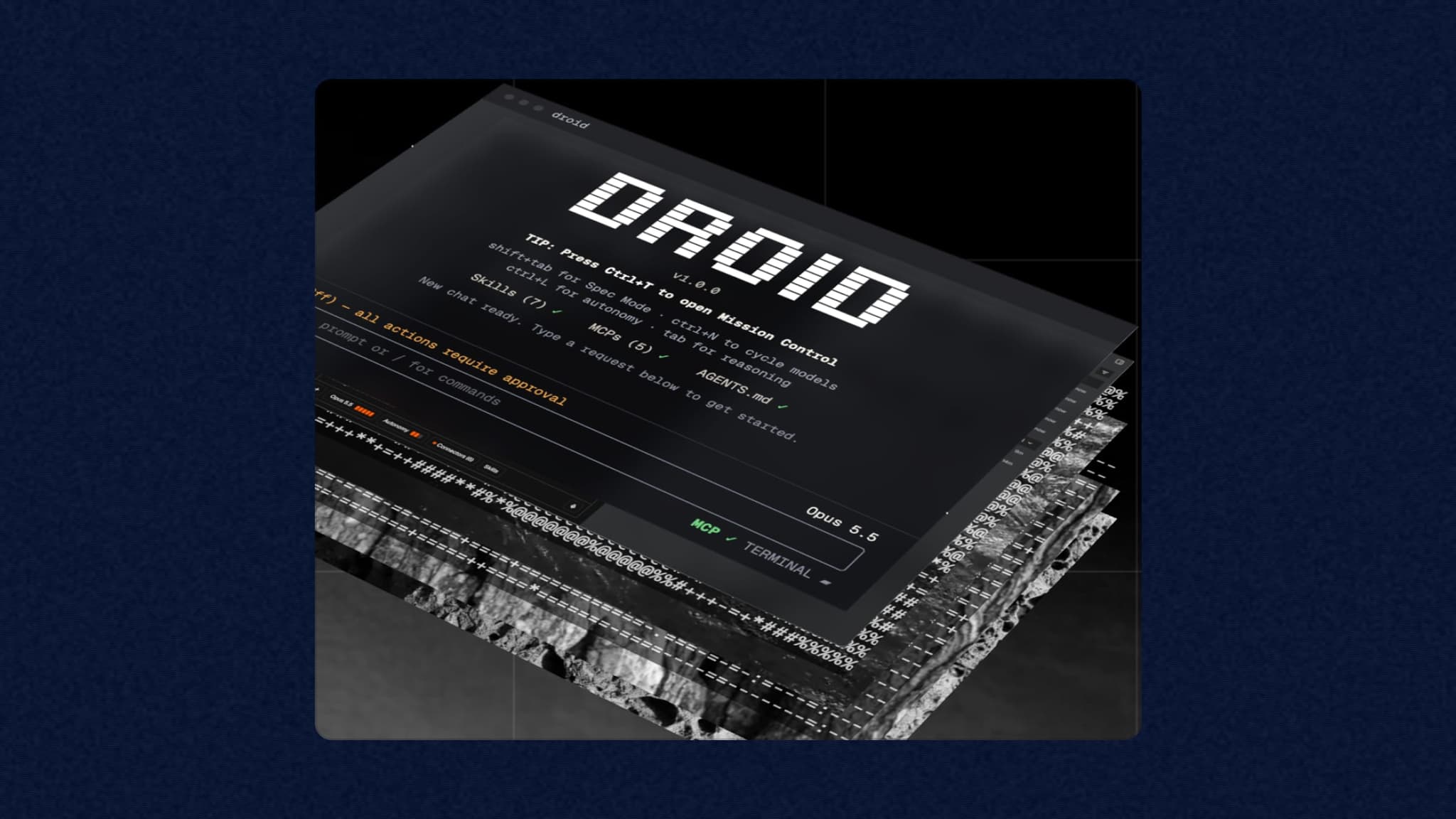
Factory, the San Francisco company that builds coding agents called Droids, released Droid 1.0 on October 29, making a Script mode the default way its agent calls tools. Instead of asking the model again after every one or two tool calls, Droid now has the model write a short program that runs many calls in one request. Factory said the change cuts Droid's cost by 15% on Claude Opus 5.5 compared with direct tool calls.
Droid 1.0 is available now as a desktop app for macOS and Windows, a terminal app and a software development kit, on plans from $20 a month for individuals. SaasBuzz has not tested it. This article describes it from Factory's launch post, its release notes and its pricing page, all read on October 31.
What Script mode does
Factory calls Droid an "agent harness," meaning the prompts, the tools and the loop that sit around whichever AI model a customer picks. In the usual loop, the model asks for a tool, reads the result, and asks again, and each request re-sends the instructions and the conversation so far. With Script mode, the model writes JavaScript that runs in a sandbox Factory says has "no file, network, or system access of its own," calls the tools from there, and reads back only what the program prints.
Factory's own example is a cleanup in the work tracker Linear. The company said on X that moving and checking 151 issues took 312 tool calls, which it estimated at about 36 requests and 3.1 million input tokens with direct calls.
Post on X by @factory
In practice, this advantage is even more apparent than in benchmarks. For example: a task to move 151 Linear issues and verify each took 312 tool calls in the past. With direct calls, that's about 36 requests and 3.1M input tokens. Now, as a Script, it took 2 requests and 61K https://t.co/TZKtnjoaaU
As a Script, Factory said, the same job took two requests and about 61,000 tokens. By SaasBuzz's arithmetic that is 98% fewer input tokens and 94% fewer requests, though the direct-call side is Factory's model of the task, not a measured run. Script mode is on by default for 10 models, including OpenAI's GPT-6.1 Sol, Anthropic's Claude Opus 5.5 and Kimi K3, according to the launch post.
Factory also said it cut the instructions sent with the first request of a session by 37%, from 20,887 tokens to 13,055, mostly by loading rarely used tools only when needed.
Factory's benchmark claims
Factory ran Droid against rival agents on Terminal-Bench 4, a set of tasks done in a command line, from October 23 to 28, three trials per task. On Claude Opus 5.5, its chart gives Droid a 65.2% pass rate against 57.6% for Anthropic's own Claude Code. On GPT-6.1 Sol it gives Droid 57.6% against 54.0% for OpenAI's Codex. Factory said Droid used 17% fewer tokens than Claude Code and 12% fewer than Codex, though it took 10% longer than Codex per passed task.
Factory CEO Matan Grinberg put the claim more broadly when he announced the release.
Post on X by @matanSF
Excited to be introducing Droid 1.0 On Terminal-Bench, @FactoryAI outperforms all others. https://t.co/sHWsUdGvgU https://t.co/zXrJXKNIBt
These are Factory's runs of its own product, not an independent test. Its methodology notes several adjustments: Opus trials stopped by Anthropic's content moderation were rerun on Claude Opus 5, and on GPT-6.1 Sol a task where the rival agent Devin stopped to ask the user a question was counted as passed if Codex passed it. Recomputed from the chart's labels, Droid's lead over Codex is 3.6 points and over the next-best agent on Opus 3.1 points, slightly more than the 3.5 and 3.0 points Factory's text gives, which suggests rounding in the labels.
What the 1.0 label covers
The version number marks a rollup more than a single drop. The release notes' own entry for CLI and Desktop v1.0.0 lists smaller items: a startup check in the doctor command, typing that works while Droid starts, and faster turn preparation when many custom models are configured. Script changes appear in the notes from at least October 3. Factory has logged 255 releases since September 30, 2025, about 4.5 a week by SaasBuzz's count, and v1.1.0 followed on October 30.
What it costs, against rivals
Factory's individual plans are Pro at $20 a month, Plus at $100 with "~5x the usage of Pro," and Max at $200 with "~10x the usage of Pro." Teams costs $60 a month per team plus $40 per seat, for up to 10 seats, which works out to $46 a seat for a full team of 10. Business and Enterprise plans are priced by sales.
Agent | Entry | Top plan |
|---|---|---|
Factory Droid | $20 | $200 |
Claude Code | $20 | $200 |
OpenAI Codex | $8 | $500 |
GitHub Copilot | $10 | $100 |
Cursor | $8 | $200 |
Monthly prices for individuals, paid plans only. Sources: Claude pricing, Codex pricing, Copilot plans, Cursor pricing, checked October 31, 2026. Cursor's $8 plan offers only Grok models.
The vendors draw the lines differently. Claude Code comes with Anthropic's paid Claude plans, Codex with ChatGPT plans or an API key, and Copilot's coding agent, which takes an assigned task and opens a pull request, starts on the $10 Pro plan. Cursor's page says third-party model usage "is not included in the monthly prices shown and must be purchased separately."
What it means for teams choosing an agent
Factory's ladder matches Anthropic's step for step. Claude's Pro, Max and Ultra plans cost $20, $100 and $200 for one, five and 10 times Pro usage, the same prices and multiples Factory lists, so by those multiples neither rewards heavier use with a lower price per unit, though Claude's Max and Ultra also include $100 and $200 a month in API credits. A buyer weighing the two is choosing agent software and a model policy, not a cheaper tier.
That policy is Factory's pitch. The launch post says Factory is "model-independent by design" and lets customers bring their own API keys, while Claude Code and Codex come from the companies that make the models. If Factory's efficiency figures hold outside its own tests, a team paying for tokens through its own keys would see them as lower bills. Two questions stay open: whether independent runs of Terminal-Bench 4 reproduce the gaps, and how Factory's usage multiples translate into tokens, which its pricing page does not say.