Anthropic's models processed 7.4% of the tokens that ran through OpenRouter in the 30 days ending October 31, 2026, but drew at least 27% of the money spent there, according to a SaasBuzz analysis of OpenRouter's own published data. DeepSeek processed 30.9% of the tokens, more than any other lab, and drew at least 4.4% of spend.
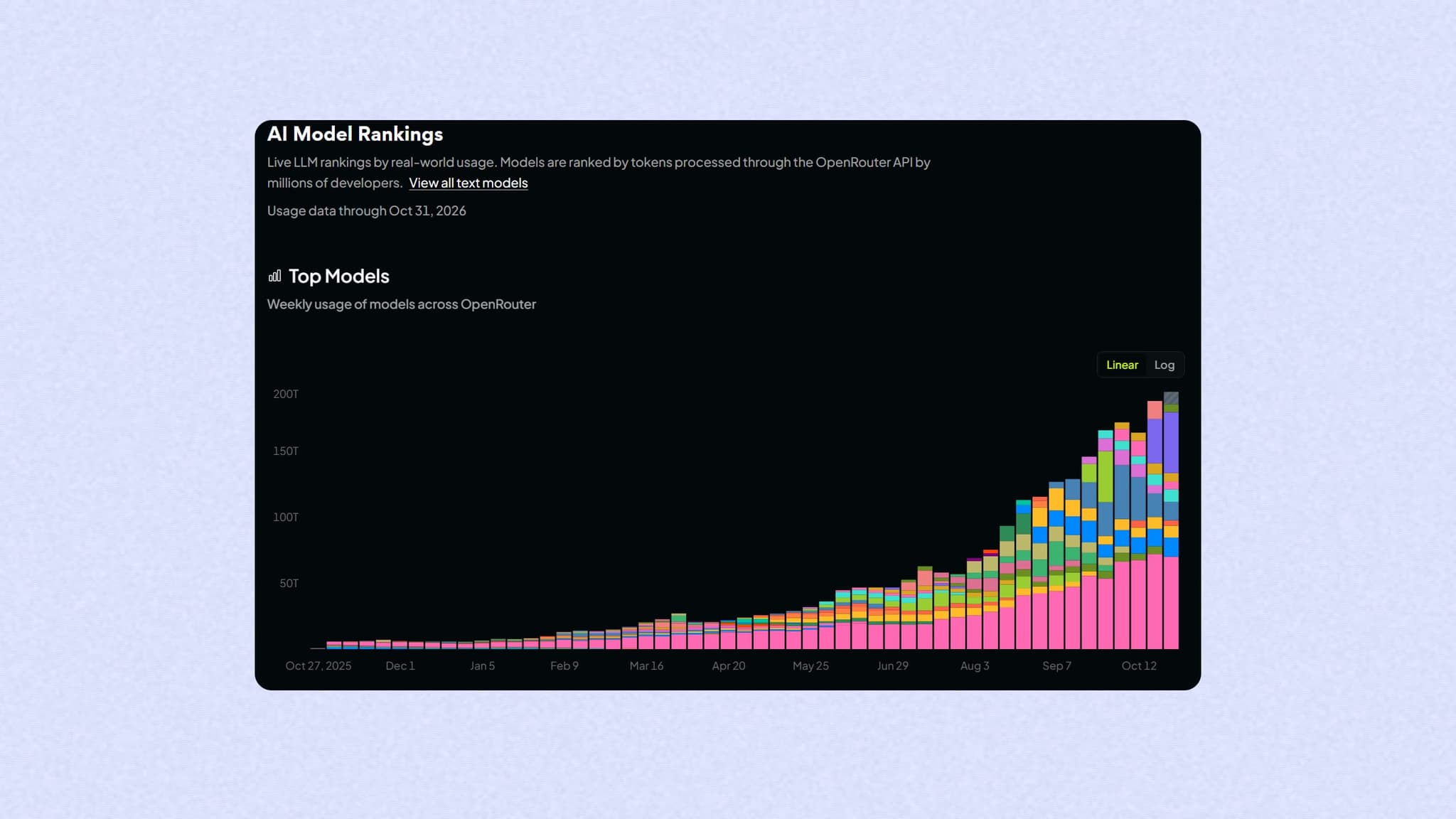
OpenRouter, a marketplace that sends developers' requests to hundreds of models through one API, ranks models by tokens. Its rankings page says plainly that "None of them measures users or spend." So SaasBuzz built two spend views from OpenRouter's own numbers: its 30-day token counts for all 736 model variants, priced at the list prices in its public models API, and the spend shares OpenRouter publishes by task on the same page. The list-price figures are SaasBuzz estimates, not billed spend.
Key findings
OpenRouter processed 763.8 trillion tokens in the 30 days ending October 31, and three labs, DeepSeek, Z.ai and OpenAI, handled 51.3% of them.
Anthropic's 7.4% of tokens would have been worth 30.7% to 43.7% of the period's spend at OpenRouter's list prices, the largest share of any lab under both pricing assumptions.
OpenRouter's own spend-by-task data credits Anthropic models with at least 27.0% of spend and OpenAI models with at least 13.1%.
A token sent to an Anthropic model cost 2.0 to 2.9 times as much at list price, on average, as one sent to an OpenAI model.
One model, Claude Opus 5.5, handled 3.5% of tokens and at least 16.5% of spend in OpenRouter's task data.
Who processes the tokens: DeepSeek, by a wide margin
DeepSeek models processed 235.9 trillion tokens in the 30 days, 30.9% of the total. Two versions of DeepSeek V4.1 Flash were the two most-used variants on the platform, at 115.5 trillion and 79.4 trillion tokens. Z.ai followed with 10.6% and OpenAI with 9.8%. Anthropic was fourth, at 7.4%.
Almost all of that volume is input. Prompt tokens made up 97.5% of the 30-day total and completion tokens 2.5%, which fits the agent and coding tools near the top of OpenRouter's apps ranking for the month, such as Claude Code, Hermes Agent and Kilo Code.
Lab | Tokens | Share |
|---|---|---|
DeepSeek | 235.9T | 30.9% |
Z.ai | 81.0T | 10.6% |
OpenAI | 74.9T | 9.8% |
Anthropic | 56.6T | 7.4% |
Tencent | 47.5T | 6.2% |
Xiaomi | 43.0T | 5.6% |
Nvidia | 33.6T | 4.4% |
StepFun | 30.3T | 4.0% |
28.5T | 3.7% | |
MiniMax | 25.1T | 3.3% |
Source: OpenRouter rankings, This Month view, usage data through October 31, 2026, prompt plus completion tokens, all 736 variants summed by author. SaasBuzz calculation.
The shift toward open-weight models is visible in OpenRouter's own Open/Closed chart. Open-weight models had 30.6% of the chart's volume in the week of November 3, 2025, and 72.7% in the week of October 19, 2026, while weekly volume rose from 5.7 trillion to 188.0 trillion. Since July the share has stayed between 66.5% and 75.1%. Lorenzo Valente, who describes himself on X as director of research, crypto, at ARK Invest, read the same chart on October 27 as a ceiling for open-weight share.
Post on X by @LorenzoARK
Hot take: open-weight has topped in market share. It went from ~30% to ~70% of OpenRouter tokens in 8 months, then flatlined since July. From here, closed models take share back
His last line is a forecast. OpenRouter's data shows the plateau, not what comes after it.
Who gets paid: Anthropic, under every view we built
Pricing the same tokens changes the order. At OpenRouter's list prices, with every input token charged at the full uncached rate, the 30 days come to $425.6 million of usage, and Anthropic's share of that is 43.7%. That version overstates spend for any model whose users reuse cached prompts, and OpenRouter wrote on October 28 that the price providers actually charge reflects real cache hit rates "so it can differ a lot from the list price."
So SaasBuzz priced the tokens a second way, charging every input token at the model's cache-read price where OpenRouter lists one. That is a heavy-caching case, not a measurement. It cuts the total to $70.2 million and Anthropic's share to 30.7%, still the largest.
Lab | Full input | Cached input |
|---|---|---|
Anthropic | 43.7% | 30.7% |
OpenAI | 19.6% | 19.9% |
StepFun | 7.0% | 4.8% |
DeepSeek | 6.7% | 8.0% |
Tencent | 6.6% | 3.4% |
5.5% | 10.2% | |
Z.ai | 1.6% | 8.0% |
Moonshot AI | 2.2% | 6.6% |
Source: SaasBuzz estimate of each lab's share of list-price value, from OpenRouter's 30-day token counts and its models API prices captured November 1, 2026. Not billed spend.
The gap comes from price per token. Averaged over everything each lab processed, Anthropic's tokens cost $3.29 per million at full list price and OpenAI's $1.13, a ratio of 2.9. In the cached case the averages are $0.38 and $0.19, a ratio of 2.0. DeepSeek's tokens averaged $0.12 per million at full list price.
The check on both estimates is OpenRouter's own spend data. Its "Top models by task" section lists, for each of 29 task types, the task's share of spend over a 30-day window and the ten models with the largest share of it. OpenRouter says the tasks "are inferred by a classifier on a representative sample of prompts." Adding up only those published top-ten lists covers 60.4% of spend, so every lab total below is a floor.
Lab | Spend, at least |
|---|---|
Anthropic | 27.0% |
OpenAI | 13.1% |
Z.ai | 6.5% |
Moonshot AI | 6.0% |
DeepSeek | 4.4% |
3.0% |
Source: OpenRouter rankings, Top models by task, spend view, 30-day window, captured November 1, 2026. SaasBuzz sum of task share times model share, top ten models per task only.
Anthropic's floor of 27.0% sits just under the low end of the list-price range, 30.7%, which is consistent with the list-price estimates, though a floor covering 60.4% of spend cannot confirm them. OpenAI's floor of 13.1% is also below both list-price estimates.
One model carries the bill
Claude Opus 5.5, priced in OpenRouter's models API at $4 per million input tokens and $20 per million output tokens, processed 26.6 trillion tokens in the 30 days, 3.5% of the total. In OpenRouter's task data it accounts for at least 16.5% of spend. It is the top model in the largest of the 29 tasks, agent workflow execution, which OpenRouter puts at 20.3% of all spend: Opus 5.5 has 23.3% of that task, against 7.6% for OpenAI's GPT-6 Astra.
By SaasBuzz's full-price estimate, Opus 5.5 alone was worth $110.4 million of the 30 days' $425.6 million. The next model, StepFun's Step 5 Preview, was worth $29.7 million.
What it means for builders, buyers and investors
Token rankings and revenue rankings answer different questions, and OpenRouter's leaderboard answers only the first. A lab can lead on tokens by being cheap enough to run inside high-volume agent loops, as DeepSeek V4.1 Flash does, and still collect a small share of the money. A lab with a small share of tokens can lead on money if its models are the ones developers pay up for in coding and agent work.
For a team choosing models, the data shows where other developers put their budget: in OpenRouter's task data, Anthropic models have at least 28.7% of spend on coding tasks, which OpenRouter puts at 27.2% of all spend. For investors reading token charts as market share, the gap between 7.4% of tokens and at least 27% of spend is the reason to ask which measure a chart uses. Anthropic's finances are set out in its IPO filing; OpenRouter is one channel among many, and its numbers say nothing about Anthropic's direct API or enterprise sales.
New prices can move these shares within a month. OpenAI's GPT-6.1 Terra, listed at $1 per million input tokens and $5 per million output tokens (SaasBuzz covered the launch), was added to OpenRouter's models API on October 26 and processed 0.55 trillion tokens before the window closed, under 1% of OpenAI's 74.9 trillion.
Method
Period: OpenRouter's This Month view, a trailing 30 days ending with the October 31, 2026 daily bucket in UTC. The task spend data covers a 30-day window whose end date OpenRouter does not state.
Tokens: prompt plus completion tokens for each model variant, as OpenRouter ranks them, read from the data behind its rankings page on November 1, 2026. Our totals match the page's own figures, such as 116 trillion tokens for DeepSeek V4.1 Flash.
Labs: the author in each model's OpenRouter slug. Models from a stealth account are counted as their own group.
Prices: list prices from OpenRouter's public models API on November 1, 2026, matched by model version and variant. Free variants count at $0. Prices that changed during the month are not reflected.
Excluded from the value estimates: 6.0% of tokens with no listed price, mostly an unnamed stealth model and two Typesafe models. Free variants were 7.6% of tokens.
Limits: OpenRouter excludes requests users keep private, and its users skew to developers and agent tools, so none of this is market share for the labs overall. The list-price figures are estimates of value at list price, not what anyone paid.
Questions
Does OpenRouter publish how much is spent on each lab?
Not as a lab total. Its rankings page says its token charts do not measure spend. Its task section publishes spend shares for the top ten models in each task, which SaasBuzz summed by lab as a floor.
Why does DeepSeek lead on tokens but not on spend?
Its most-used models are among the cheapest on the platform. DeepSeek's tokens averaged $0.12 per million at full list price, against $3.29 for Anthropic.
Is this Anthropic's share of the AI model market?
No. It covers traffic through OpenRouter only, a marketplace used mostly by developers and agent tools, and leaves out each lab's direct API and enterprise sales.