DeepSeek has published dsh-superagent, an open-source coding agent that watches one GitHub repository, takes requests from approved people and answers with work such as a pull request. The code is under the MIT license, and its README calls it a "research prototype for reference only, not an official DeepSeek product."
The repository went up on October 31 at 9:32 a.m. UTC and had passed 5,000 stars on GitHub by the next morning. Bloomberg's headline cast it as an attempt to rival Anthropic, whose Claude Code is the obvious comparison. The repository itself names no rival.
What dsh-superagent does
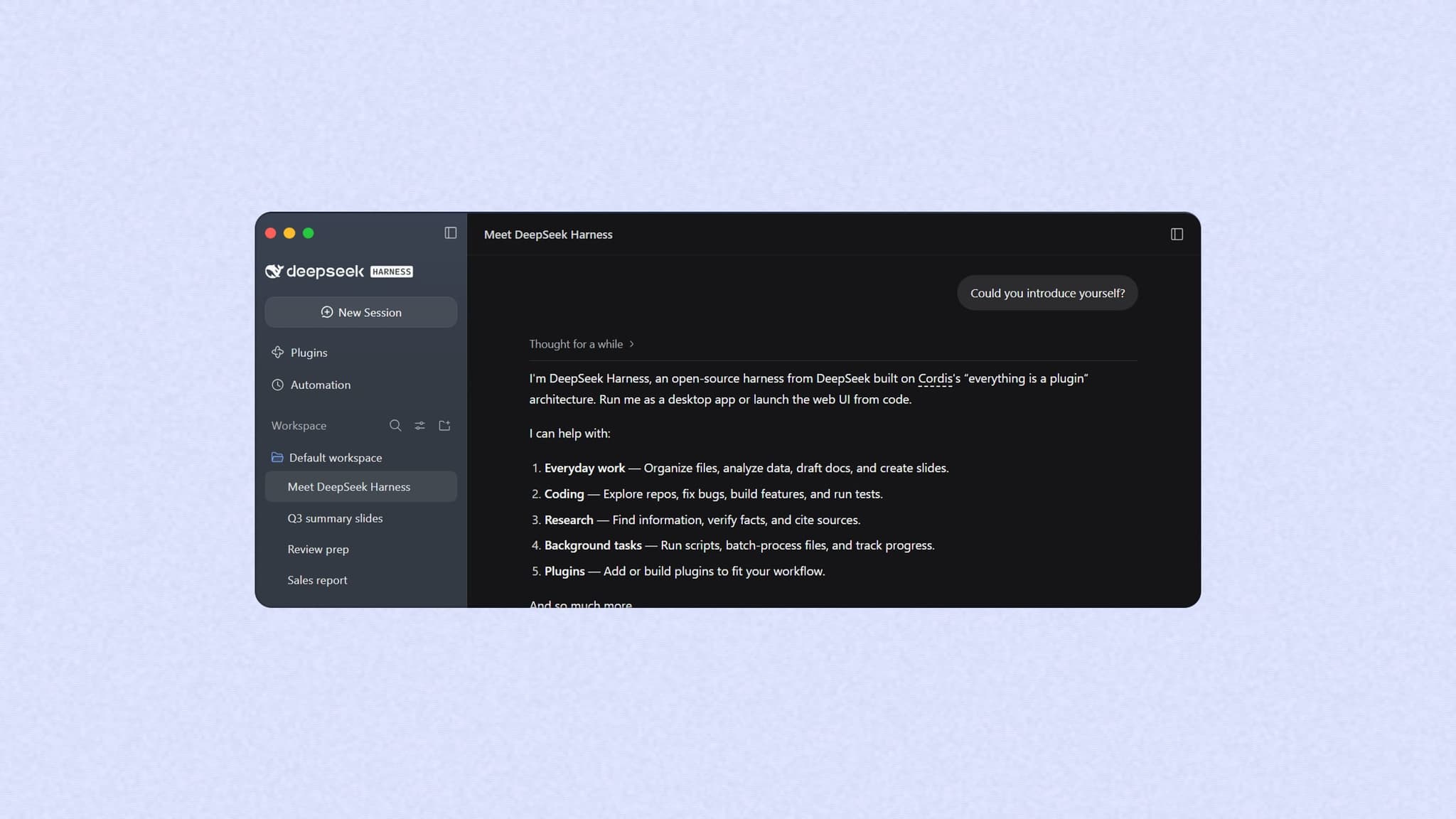
Its package file describes it as "a DSH (DeepSeek Harness) bundle." DSH is the company's open-source agent runtime, which DeepSeek describes as "now in public preview." Once set up on a team's own machine, the agent works like this:
It listens to GitHub notifications and, optionally, chats in Feishu, the workplace messenger.
Someone on an allowed list writes a request, for example a comment that mentions the agent's account on an issue.
The agent opens a work item, which the docs call a Ticket, and gives it its own session and directory.
It answers in the original conversation, for example with a pull request, and a local web panel shows what needs a person.
The router and workers that coverage described are in the execution guide. A main session runs with a preset called dsh-superagent-router and "a smaller tool set for routing." Each Ticket gets its own worker session, and several can run at once, up to a configured number of worker slots.
DeepSeek's design goal, in the README, is to "take as little human attention as possible, and give as much value as possible." By default the agent acts only when asked: its setup guide starts proactive work in an observe mode, "which records proactive work without doing it."
Hugging Face's head of research, Leandro von Werra, summed up the release for his followers on X on October 31:
Post on X by @lvwerra
Another DeepSeek drop: dsh-superagent An agent framework that works through a repo's GitHub issues and PRs with many agents in parallel, designed to take as little human attention as possible while delivering as much value as possible.
What is a prototype, and what isn't there
The README says the code "grew out of our team's day-to-day development work, with much of the engineering done by coding agents," and warns that it "may still contain bugs." It also says some designs in DeepSeek's accompanying article, Exploring Super-agent Design, "are directions for future development and are not implemented in this prototype."
The safety notes are blunt. Workers "run commands without approval as the operator's OS user," and the account wrappers "establish defaults, not a security boundary," according to the docs. The deployment guide says a worker can read the operator's home directory, and recommends a dedicated OS account for isolation.
Setup is long enough that the README tells users to have a coding agent do it. The prerequisites include Node.js, pnpm, git, tmux, Python and the GitHub CLI, and the agent needs its own GitHub account.
Which models, and what they cost
The agent names no model. It "uses the profile's default model unless the Eval or Execution settings name another," the deployment guide says, and DSH's own page shows a DeepSeek Flash model selected. DeepSeek's API pricing page lists two models:
Model | Input | Output |
|---|---|---|
DeepSeek Flash | $0.30 | $1.20 |
DeepSeek V4 Pro | $1.32 | $3.96 |
Claude Sonnet 5.5 | $2 | $10 |
Claude Opus 5.5 | $4 | $20 |
US dollars per million tokens. DeepSeek rows are peak rates, input on a cache miss. Sources: the DeepSeek and Anthropic pricing pages, checked November 1, 2026.
DeepSeek charges half those rates off-peak. Its peak hours are 1:00 to 4:00 and 6:00 to 10:00 UTC, Monday through Friday, which is 8 to 11 p.m. Eastern time Sunday through Thursday and 1 to 5 a.m. Monday through Friday now that daylight saving has ended. By SaasBuzz's calculation, a team working 9 a.m. to 5 p.m. ET never hits a peak hour, and pays $0.60 per million output tokens on Flash.
At those rates, Claude Opus 5.5 output costs about 10 times DeepSeek V4 Pro's off-peak rate, and Claude Sonnet 5.5 output about 17 times Flash's. The comparison is rough: Anthropic says its newer tokenizer "produces approximately 30% more tokens for the same text," so a token is not the same unit across providers.
How it compares with Claude Code and Codex
The workflow is not new on its own. Anthropic's Claude Code GitHub Actions responds "whenever someone mentions @claude in an issue or pull request," and Anthropic says it can turn issues into pull requests. OpenAI's Codex GitHub integration posts a review when someone comments "@codex review" on a pull request.
The difference is where the agent lives. Claude Code's action runs inside the repository's GitHub Actions workflows, started by each mention. DeepSeek's prototype is a long-running service on the operator's own machine, with a queue, worker slots and a panel, and the code is open to change.
DeepSeek also does not need teams to switch tools to sell them tokens. Its pricing page lists Claude Code and Codex among its "Agent Integrations" and offers an Anthropic-format endpoint. It also says search and fetch calls made through DSH, Claude Code or Codex move to per-request billing, $0.75 per 1,000, from midnight on November 1, Beijing time.
What it means for teams paying for Claude Code
For buyers, the release splits into two offers. One is a free, open design for an always-on team agent that a company can run and modify itself. The other is the models underneath, priced at a fraction of Claude's and usable inside Claude Code itself. For Anthropic, which filed to list on Nasdaq on October 26, the second offer is the sharper one: a team can keep Claude Code's workflow and send the tokens to DeepSeek.
What DeepSeek has not published is any measure of how well this prototype's pull requests hold up. SaasBuzz has not run it. Its README asks users to "review and adapt it" before using it in their own environment.