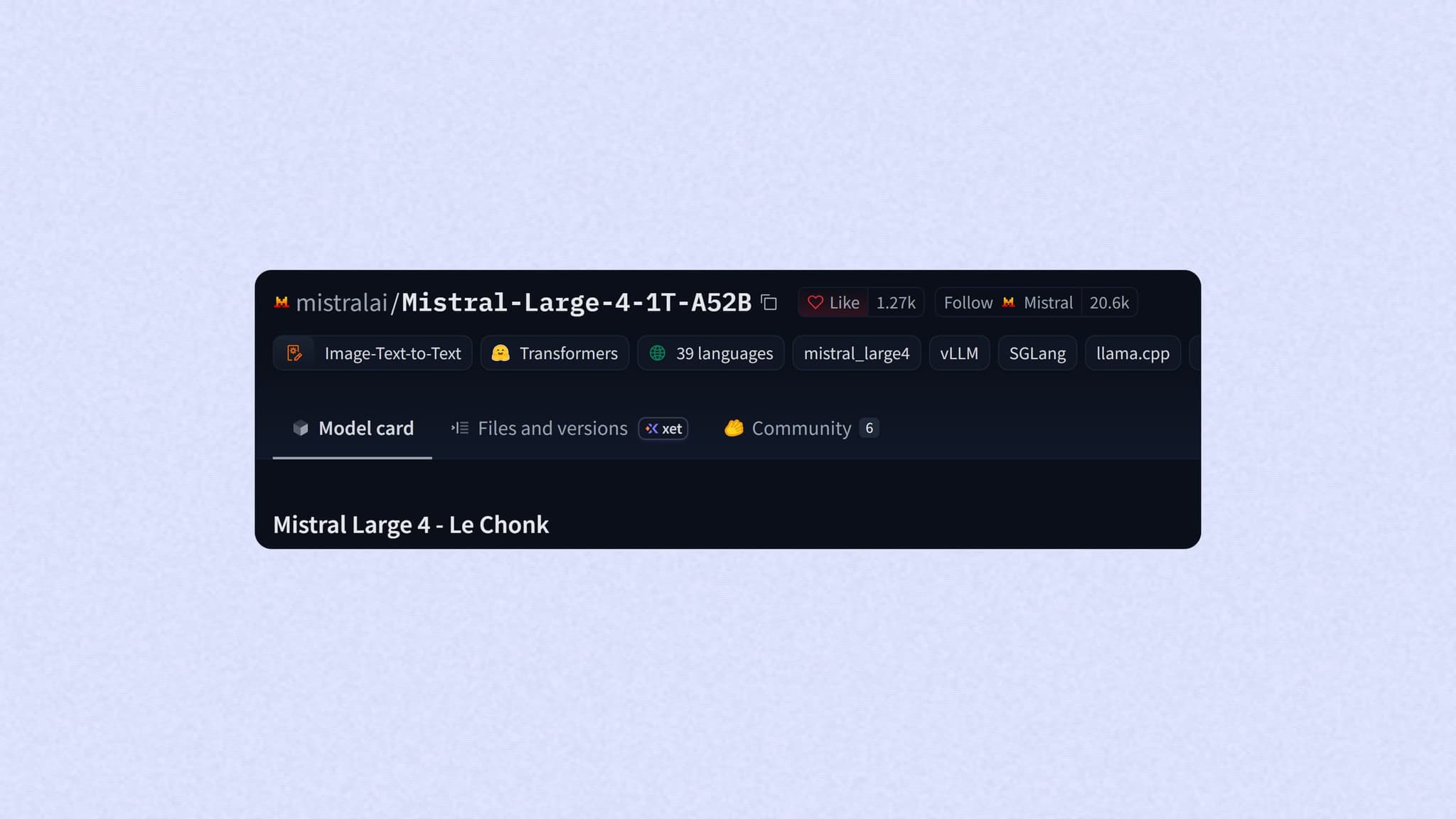
Mistral AI released the open weights of Mistral Large 4 on October 29, putting its flagship model, nicknamed Le Chonk, on Hugging Face for anyone to download, fine-tune and run. The launch post calls it a 1-trillion-parameter, natively multimodal model aimed at agentic coding and cybersecurity, and prices the hosted version at $0.70 per million input tokens and $2.10 per million output tokens.
The weights are free to use commercially under a modified MIT license, with one catch: a company that runs a model-as-a-service business needs a separate license from Mistral. Mistral first released the model as a public preview earlier in October.
What developers and companies actually get
The model card describes a mixture-of-experts model with 49 billion active parameters per token (52 billion counting embeddings and output layers), 128 routed experts with four active per token, a 1 million token context window, and text and image input with text output. Mistral says it was trained from scratch on 3,800 Nvidia Grace Blackwell GPUs in its own data centers in Europe. Artificial Analysis and Cloudera put the total at 1.05 trillion parameters rather than an even trillion.
Only 4.9% of the model's parameters work on any one token, which keeps it cheap to serve for its size. The main FP8 checkpoint takes 1.06 terabytes on Hugging Face, and a separate NVFP4 version for Nvidia's Blackwell GPUs takes 610 gigabytes, 42% less. The model card's serving examples for vLLM and SGLang split the model across eight GPUs in one node: at FP8 that is about 133 gigabytes of weights on each GPU before any working memory, and about 76 gigabytes with NVFP4, by SaasBuzz's calculation.
The Mistral Ecosystem Open-Weight License exempts internal use and use through Mistral's own products. It defines a model as a service as giving a third party access to the model "in a manner that allows such third party to exercise meaningful control over the inputs, parameters, or training data," and excludes end-user products that embed the model inside specific features. A software company that embeds Large 4 within specific features of its own product can ship it; one that resells it as an API needs a deal with Mistral.
How the benchmark claims hold up
Mistral's main claims lean on Artificial Analysis, an independent benchmarking firm. Mistral says Large 4 scores 48% on the firm's Coding Agent Index, "effectively tied" with China's GLM-5.3 while using 47% fewer tokens per task. Artificial Analysis posted its own ranking on X, which puts Large 4 one point behind:
Running in Mistral Vibe, Mistral Large 4 (high) ranks second of the current open weights models on the Artificial Analysis Coding Agent Index (48), between GLM-5.3 (max) in Opencode (49) and DeepSeek V4.1 Flash 1017 (max) in DeepSeek Harness (46)Artificial Analysis, on X, October 29, 2026
The firm's general Intelligence Index is less flattering. Its comparison page scores Large 4 at 26 against 32 for GLM-5.3, and lists Large 4 at 25% on Terminal-Bench 4.0 within that index, against 42% for GLM-5.3. Mistral's launch post reports 41% on Terminal-Bench 4.0, in a chart it labels as the Coding Agent Index, where the model runs inside Mistral's own coding agent. The two setups are 16 points apart, so buyers comparing models should check which one a number comes from. Artificial Analysis still called Large 4 "narrowly" the top open-weight model developed outside China.
Measure | Large 4 | GLM-5.3 |
|---|---|---|
Input, per 1M | $0.70 | $1.40 |
Output, per 1M | $2.10 | $4.40 |
Cost per task | $2.06 | $5.01 |
Intel. Index | 26 | 32 |
Active params | 52B | 40B |
Source: Artificial Analysis model comparison, Large 4 at high reasoning and GLM-5.3 at max, checked October 30, 2026.
Price is where Large 4 wins clearly. At the prices Artificial Analysis lists, its input tokens cost 50% less than GLM-5.3's and its output tokens 52% less, and it averaged 82,000 output tokens per index task against 119,000, or 31% fewer. Together that makes each task 59% cheaper. A team sending 1 billion input tokens and 200 million output tokens a month would pay about $1,120 on Mistral's API, against about $2,280 for GLM-5.3 at those prices, by SaasBuzz's calculation.
What the industry is saying
Mistral's own account announced the release on X by pointing to an outside test rather than its own:
Le Chonk ranks #1 on @cognition's FrontierCode among open modelsMistral AI, on X, October 29, 2026
Pierre Stock, Mistral's vice president of science, made the sovereignty case to TechCrunch, describing "access that can't be cut off by definition because the model is open-weighted." Marjorie Janiewicz, Mistral's chief revenue officer, said at Cloudera's EVOLVE26 event that companies "need to own those models so that the day somebody decides to unplug them, they have business continuity," SiliconANGLE reported. Cloudera's October 27 release says its existing Mistral partnership "remains central to its sovereign inference strategy."
The open-source serving project vLLM, which the model card uses in its serving examples, reported an early training result showing the weights already being tuned by outsiders:
On 8 @nvidia GB200 nodes, LoRA RL on the NVFP4 checkpoint brings AIME 2024 avg@8 from ~64% to ~75% in 75 training steps.vLLM, on X, October 29, 2026
Analysts were more cautious. Mistral's post says that while monitoring cybersecurity use, "we see a potential for uplift to conduct real attacks," and that it is "modifying our guardrails accordingly." Charlie Dai, vice president and principal analyst at Forrester, told CSO Online that "without a detailed technical report, the best open-weight model claim remains difficult to validate across workloads." Niyati Daftary, principal analyst at Gartner, told the same outlet that Mistral's 96.6% refusal rate on malicious cyber prompts "tells you what their model does in their test scenario."
What it means for software buyers and builders
For companies that will not send code or customer data to an outside API, Large 4 is now the top-ranked open-weight model from outside China, by Artificial Analysis's count, that they can run entirely on their own hardware under a license that allows commercial use. The cost is infrastructure: a terabyte of weights and a multi-GPU node, within reach of banks, governments and large vendors rather than most startups.
For software vendors, the license line matters most. Embedding Large 4 inside a product's features is allowed; offering it as a general endpoint that customers control is not, without a deal. On capability, the independent numbers say Large 4 sits with the best open models on coding agents and trails GLM-5.3 on general reasoning, so the case for it rests on price, token efficiency and where it was built. SaasBuzz has not tested the model. For the closed-model side of the market, see SaasBuzz's coverage of OpenAI's GPT-6.1 Terra launch.